前情提要:
3. 醛和酮转变成醇
醛和酮还原转变成醇的方法一直是分别制备伯醇和仲醇的一个较为常用的方法。还原醛和酮到醇主要方法可以分为两类:化学还原法和催化氢化法。
3.1醛和酮的加氢还原
醛和酮的羰基也可通过加氢还原为相应的伯醇和仲醇。催化剂一般为负载在载体上的镍、铬、铜或铜铬等。若加氢原料含有硫化物,则采用镍、钴或钨的氧化物或硫化物型抗硫催化剂。
醛和酮的氢化活性通常大于芳环而小于不饱和键。醛比酮更易氢化,所以醛加氢条件比较温和,一般温度为50~150℃(采用镍或铬催化剂)或200~250℃(采用硫化物催化剂);而酮加氢的条件在采用上述相同的催化剂时则相应的温度为150~250℃及300~350℃。为了加速反应,及提高平衡反应的转移,这类化合物加氢时也在压力下进行。用镍催化剂时,压力为1~2Mpa,铬催化剂时为5~20Mpa,而用硫化物催化剂时则为30Mpa。
脂肪族醛,酮的氢化活性较之芳香族醛,酮为低,通常用Raney镍和铂为催化剂,而钯催化剂的效果较差。一般需在较高温度和压力下还原。例如,由葡萄糖氢化得到山梨醇(sorbitol)。
 芳香醛酮的氢化还原,如用钯为催化剂,在加氢剧烈时生成的醇会进一步氢解为烃特别对于芳环上有强推电子基团存在或二芳基酮(参见脱羰基一文)。但如选用适当活性的Raney镍为催化剂,在温和的条件下,可得到醇。如天麻素(gastrodine)中间体的制备。
 催化剂钌,铑,铱等金属的三苯膦等配合物,在强碱条件下,可成功地还原脂肪酮和芳香酮为相应的醇
 3.1.1醛和酮的加氢还原示例
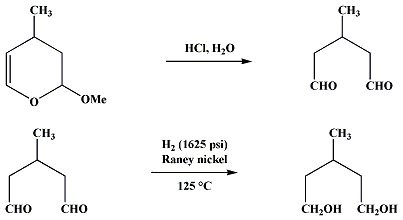 In a 2-l. three-necked flask equipped with a stirrer and thermometer are placed 336 g. (2.62 moles) of 3,4-dihydro-2-methoxy-4-methyl-2H-pyran, 630 ml. of water, and 24 ml. of concentrated hydrochloric acid. The mixture is stirred for 2 hours, during which the temperature may reach 50℃but should not be permitted to rise higher. Solid sodium bicarbonate is then added until the solution is neutral to pH indicator paper. The entire reaction mixture weighing about 1 kg. together with 39 g. of Raney nickel2 is introduced into a 3-l. stainless-steel rocking hydrogenation autoclave. A hydrogen pressure of at least 1625 p.s.i. is applied, and the autoclave is heated to 125℃and held there with shaking for 4 hours. The mixture is allowed to cool overnight, and the catalyst is separated either by suction filtration through Filter-Cel or by centrifugation. The solution is distilled through a 12-in. Vigreux column. After the methanol and water are separated, the 3-methyl-1,5-pentanediol distils at 139–146℃/17 mm., 149–150℃/25 mm. The yield is 251–256 g. (81–83%), n25D 1.4512–1.4521.
3.2金属还原
醛、酮能被多种金属还原剂还原成醇。这些金属有锂、钠、钾碱金属;铝、铁、锌等。他们和特定的试剂配合成常用的还原体系。如锂、钠、钾-氨、钠、钾-醇、铝-汞、铁-乙酸、锌-乙醇等。如钙拮抗剂盐酸马尼地平(Manidipine)中间体二苯甲醇的的制备,通过锌-乙醇还原二苯甲酮的收率达到90%~92%。
 3.2.1Na-NH3体系还原酮示例
 A 5-L, three-necked, round-bottomed flask is equipped with a variable speed Hershberg stirrer and a 500-mL Dewar condenser filled with dry ice–acetone and connected by its upper joint to a mineral oil bubbler through which passes dry nitrogengas. The flask is immersed in a dry ice–acetone bath, flushed well withnitrogenand 3000 mL ofammoniais condensed into the flask via a glass tube passed through a rubber septum in the remaining neck of the flask. Cleansodium, 125 g (5.43 g-atom), is added slowly to theammoniawith slow stirring. Then 250.3 g (0.906 mol) of5-methyl-2-[1-methyl-1-(phenylmethylthio)ethyl]cyclohexanoneand 72.5 mL (1.8 mol) ofmethanolin 625 mL of anhydrousetherare added dropwise via a pressure-equalized addition funnel over 5 hr to the vigorously stirred (ca. 500 rpm) solution. Stirring is continued an additional 30 min following which 150 mL ofmethanol is added over 2.5 hr dropwise (to avoid a violent eruption). The solution is allowed to warm slowly and the addition funnel and the condenser are removed to allow the ammoniato evaporate overnight. The reaction flask is immersed in an ice bath and 700 mL of water is added cautiously over an hour to the yellow solid left by evaporation of theammonia. The solution is transferred to a 2-L separatory funnel and extracted with two 200-mL portions ofether, which are discarded. The aqueous layer is poured into a mixture of 500 mL of concentratedhydrochloric acidand 1000 g of ice, transferred to a 4-L separatory funnel, and extracted with four 200-mL portions ofether. The combined etherextracts are washed with 200 mL of water and 200 mL of saturated aqueoussodium chloride, dried over magnesium sulfate, and concentrated by rotary evaporation at aspirator vacuum. The residual liquid is placed under reduced pressure (0.2 mm) for 1 hr to remove the remaining solvent to give 137–140 g (80–82%) of an orange oil that is a diastereomeric mixture of which the major component constitutes 80%, as indicated by13C NMR.
3.2.2 Na-EtOH体系还原酮示例
 In a 3-l. round-bottomed flask, fitted with an efficient Liebig condenser (100 by 1 cm.), 228 g. (2 moles) ofmethyln-amyl ketoneis dissolved in a mixture of 600 cc. of 95 per centalcoholand 200 cc. of water. One hundred thirty grams (5.6 gram atoms) ofsodiumin the form of wire is gradually added through the condenser. During the addition of thesodiumthe flask is cooled with running water so that the reaction does not become unduly violent.When the sodiumhas dissolved, 2 l. of water is added and the mixture is cooled to 15℃. The upper oily layer is then separated, washed with 50 cc. of 1:1hydrochloric acidand then with 50 cc. of water, dried over 20 g. of anhydroussodium sulfate, and distilled with a fractionating column. After a small fore-run of low-boiling liquid, the pureheptanoldistils at 155–157.5℃. The yield is 145–150 g. (62–65 per cent of the theoretical amount).3.2.3Na(Hg)体系还原酮示例
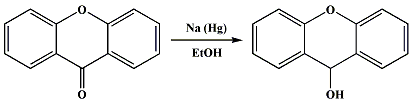 An amalgam prepared from 9.0 g. (0.39 atom) ofsodium and 750 g. (55 cc.) of mercuryis warmed to about 50℃in a 500-cc. Pyrex round-bottomed flask. To it is then added a cold suspension of 25 g. (0.13 mole) ofxanthonein 175 cc. of 95 per centethyl alcohol. The flask is at once stoppered, held in a cloth, and vigorously shaken, the stopper being raised from time to time to release any pressure. The temperature rises rapidly to 60–70℃. The solidxanthonerapidly goes into solution, a very faint and transient blue color being developed. At the end of about five minutes the alcoholic solution is clear and practically colorless.
After a further ten-minute shaking the mercuryis separated and washed with 10–15 cc. ofalcohol. The alcoholic solution is filtered while warm and slowly poured with stirring into 2 l. of cold distilled water. The precipitated xanthydrolis filtered with suction, washed with water until free of alkali, and dried at 40–50℃to constant weight. The crystalline product, which weighs 23–24 g. (91–95 per cent of the theoretical amount), melts at 121–123℃.3.2.4Fe-HOAc体系还原酮示例
 In a 12-l. flask fitted with a mechanical stirrer and a short reflux condenser are placed 1800 g. (32.2 atoms) ofiron filings, 3 l. (52.5 moles) of glacialacetic acid, 3 l. of water, and 450 g. (3.95 moles) ofheptaldehyde. The mixture is heated on the steam bath, with stirring, for six to seven hours. The flask is then fitted to an apparatus for steam distillation and the mixture distilled in a current of steam until no more oil passes over (7–8 l. of distillate). The oil is then separated, and the aqueous part distilled to recover a small quantity of dissolved or suspendedheptyl alcohol.
The combined product is mixed with 1 l. of 20 per centsodium hydroxide solution and stirred on the steam bath for four hours, in order to hydrolyze a small proportion of heptyl acetate. The oil is then separated and distilled, and the portion boiling at 172–176℃is collected. The residue in the flask is mixed with about 100 cc. of water and distilled, whereupon a further small quantity of oil passes over with the steam. This distillate and the forerun are freed of the bulk of the water in a separatory funnel and distilled from a smaller flask. In this way the total yield ofn-heptyl alcohol boiling at 172–176℃(uncorr.) is 350–370 g. (75–81 per cent of the theoretical amount). The alcohol may be redistilled under reduced pressure, when it passes over almost without loss at 71–72℃/12 mm.3.2.5n-EtOH体系还原酮示例
In a 3-l. round-bottomed flask fitted with a mechanical stirrer are placed 200 g. of technical flakesodium hydroxide, 200 g. ofbenzophenone, 2 l. of 95 per centalcohol, and 200 g. of technicalzincdust. The stirrer is started and the mixture slowly warms to about 70° spontaneously. After two to three hours the mixture, which has started to cool, is filtered with suction, and the residue is washed twice with 100-cc. portions of hotalcohol
The filtrate is poured into five volumes of ice water acidified with about 425 cc. of concentrated commercialhydrochloric acid. The benzohydrol separates as a white crystalline mass and is filtered by suction. The yield of crude air-dried product melting at 65℃is 194–196 g. (96–97 per cent of the theoretical amount). From 200 g. of crude product in 200 cc. of hotalcoholthere is obtained, after cooling in an ice-salt mixture, filtering, and drying, 140–145 g. of product melting at 68℃. The benzohydrol remaining in the mother liquors may be precipitated with water.
🔙返回上一页🔙